Watch Mike’s video here, or read on for the full story.
Gravity returns
Warren Buffett once said that interest rates are to asset prices what gravity is to the apple. September was a reminder of just how strong that pull can be. The US 10 year Treasury yield pushed through 5% mid-month and finished the month above 5.2%, its highest level since 2007. Closer to home, the Reserve Bank lifted the OCR to 2.75% on 2 September, its second hike in a row, and our own 10 year government bond rate sat around 5%.
The driver is the same one I've been writing about for months. Higher oil prices are keeping inflation sticky, the US economy is holding up, and the bond market is once again calling the shots.
When bonds don't behave like bonds
For context, when interest rates rise, the price of existing bonds falls. If new bonds pay more, the old ones paying less are worth less. Most of the time bonds are the ballast in a portfolio, the part that holds steady when shares wobble. In September they did the opposite. The Pie Fixed Income Fund returned -1.8% and the Pie Conservative Fund returned -1.6%, a rough month for funds designed to be the steady hand (after fees, before tax).
The same gravity applies to interest rate sensitive shares: property, infrastructure, utilities and high dividend payers. These companies tend to carry more debt, and their steady income looks less attractive when you can get 5% from a government bond. The Pie Property & Infrastructure Fund returned -5.1% and the Pie Australasian Dividend Growth Fund returned -3.5% (after fees, before tax). For the most part, the businesses haven't changed. What has changed is how much investors will pay for them. When a government bond pays 5% with little risk, a company’s steady dividend looks less attractive, so investors pay less for its shares, even if the business is doing just as well.
Meta finds its Muse
On the other side of the ledger, Meta launched Muse on 8 September, a personal AI agent built on its new Muse Spark models. Within 12 days it was the top free app on the US App Store, with around 2.5 million downloads, outpacing ChatGPT's early trajectory. Meta's share price rose roughly 36% in September, its best month since July 2013.1 For a company of Meta's size, that is an extraordinary move.
What interests me most is the turnaround in sentiment. Not long ago the market was punishing Meta for how much it was spending on AI. Now it has a product consumers clearly want. This is what AI bulls like me have been waiting for: evidence that the enormous spend turns into products people actually use.
It’s also a good answer to the sceptics. Last month I mentioned tech writer Ed Zitron’s “AI is fake” theory: the argument that AI is a bubble, with tech companies spending hundreds of billions on something that hasn’t yet produced products people will use or pay for in big numbers. I don’t agree with him, and two and a half million downloads in under two weeks suggests consumers don’t either.
How our other funds fared
It was another two speed month. The Pie Global Growth Fund returned +1.4% and the Pie Global Growth 2 Fund +0.9%, with our AI and technology names doing the heavy lifting against the headwind of rising rates. Our Australasian funds went backwards, with the Pie Australasian Growth Fund and the Pie Australasian Emerging Companies Fund both returning -0.9%, and the Pie Australasian Growth 2 Fund -6.7% (all returns after fees, before tax).
A word to our Australasian investors
I know it has been a tough stretch. With the exception of the Emerging Companies Fund, our Australasian Funds have been in a fall since October 2025. Rising rates, a property market with a long hangover and a squeezed consumer have made this a hard market to make money in.
I thought it would be worth sharing a chart we’ve put together for our upcoming investor roadshow next month showing every fall the Pie Australasian Dividend Growth Fund has had since it launched in September 2011 (see below). It isn't pretty viewing.
There have been eight falls of more than 10% in 15 years, about one every two years. The worst was -36% during Covid in 2020, and the current fall, at -32% at its worst, is the second biggest in the Fund's history. The Fund has spent 22% of all days 10% or more below its previous high. In other words, more than one day in five, if you checked your balance, it would have felt like you were going backwards.
And yet, $10,000 invested at the start has grown to about $65,000 with distributions reinvested, even after this year's fall. That's 13.2% a year after fees.2 The average fall was 20%. The average rise that followed was 48%. The biggest fall, Covid, was back to even in five months. Every one of those falls came with a good reason to sell. The money was made by the people who stayed in through them.
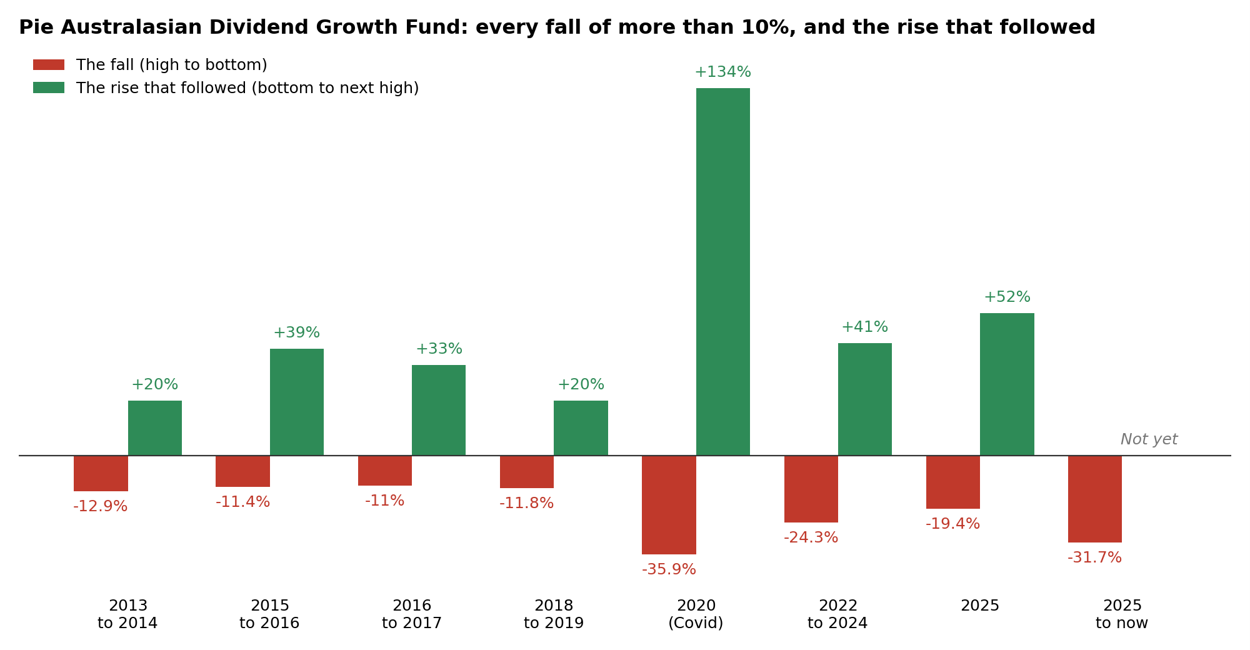
Source: Pie Funds Management, Australasian Dividend Growth Fund daily unit prices, 1 September 2011 to 7 October 2026, after fees and before tax. Unit prices exclude the Fund's half-yearly distributions, so falls shown are slightly deeper, and recoveries slightly slower, than an investor with distributions reinvested experienced. The current fall, from October 2025, has no rise yet. Past performance is not a reliable indicator of future returns.
None of this makes the current fall any easier to live with and, as an investor in this fund myself, I’m feeling the pain too. Falls like this are part of investing in concentrated, high conviction funds. That’s also why funds like these work best as one part of a well diversified portfolio, not the whole of it. If the last year has been more than you’re comfortable with, please talk to us or a financial adviser about whether your investments still suit your goals and how much risk you want to take.
Where to from here?
Rates are the thing to watch. If energy-driven inflation starts to ease, the pressure on bonds and rate sensitive shares could reverse quickly, and those are exactly the areas that have been sold the hardest. For bond investors there is also a silver lining. The starting yield is the best guide to future bond returns and yields of around 5% are a much better starting point than we've had for most of the last decade.
I'll be talking more about this, and the other lessons from nearly 20 years of Pie, at our
investor roadshow in November. I hope to see you there.
As always, thank you for your ongoing trust.
1 CNBC, Invezz and Forbes reporting, September 2026.
2 Pie Funds Management, Australasian Dividend Growth Fund, 1 September 2011 to 7 October 2026, after fees and before tax, distributions reinvested. Since-inception return of 13.2% p.a. as published at 30 September 2026. Past performance is not a reliable indicator of future returns.
Information is current as at 12 October 2026. Pie Funds Management Limited ("Pie Funds") is the manager and issuer of the funds in the Pie Funds Management Scheme and Pie KiwiSaver Scheme (the “Schemes”), the product disclosure statements of which can be found at www.piefunds.co.nz. Any advice is given by Pie Funds and is general only. Our advice relates only to the specific financial products mentioned and does not account for personal circumstances or financial goals. Please see a financial adviser for tailored advice. You may have to pay product or other fees, like brokerage, if you act on any advice. As manager of the Schemes' investment funds, we receive fees determined by your balance and we benefit financially if you invest in our products. We manage this conflict of interest via an internal compliance framework designed to help us meet our duties to you. For information about how we can help you, our duties and complaint process and how disputes can be resolved, or to see our disclosure statement, please visit www.piefunds.co.nz. Please let us know if you would like a hard copy of this disclosure information. Past performance is not a guarantee of future returns. Returns can be negative as well as positive and returns over different periods may vary. The information is given in good faith and has been derived from sources believed to be reliable and accurate. However, neither Pie Funds nor any of its employees or directors gives any warranty of reliability or accuracy and shall not be liable for errors or omissions herein, or any loss or damage sustained by any person relying on such information, whatever the cause of loss or damage. No person, including the directors of Pie Funds, guarantees the repayment of units in the Schemes or any returns of units in the Schemes.